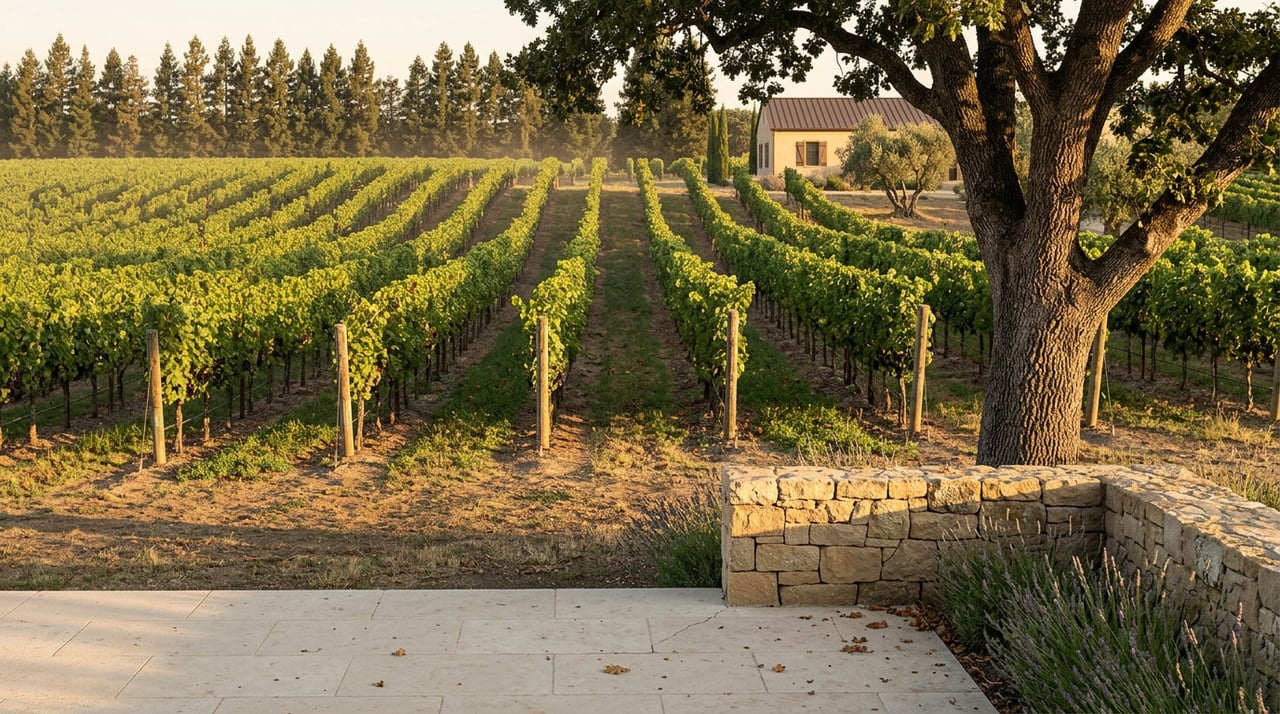
In March 2026, longtime Napa Valley vintner Dario Sattui placed a conservation easement on a parcel of land in the Coombsville hills overlooking the city of Napa. It was his fifth such agreement with the Land Trust of Napa County, joining Carsi Vineyard, the historic Hibbard Ranch and his certified organic Vittorio's Estate under permanent protection. In his own words, he said he'd "seen tremendous development in the 44 years I have lived in Napa County" and wanted to be part of the solution.
That single decision tells you more about how Napa real estate actually prices than any median-price headline will. While the county's own tax assessor was busy lowering the assessed value of dozens of vineyard and hospitality properties this year, a legacy Napa Valley owner was voluntarily locking up more land, forever, at the exact moment a naive reading of the market would suggest loosening the reins might make more sense. Understanding why those two things happened in the same year, without contradicting each other, is the difference between reading Napa's market correctly and reading it like a national headline.
Two data points that look like they disagree
Napa County Assessor-Recorder-County Clerk John Tuteur delivered the 2026-27 assessment roll this year at $59.3 billion, an increase of just 3.12% over last year, the smallest gain since the county began recovering from the Great Recession in 2012. Getting there required declines in value on 97 vineyard, winery and hospitality properties, because, as Tuteur put it, the roll's slower growth reflected conditions "impacted by the economic headwinds impacting the winegrape and real estate industries."
Zoom into residential sales and the same softening shows up in the numbers buyers actually watch. Inside city limits, the median sale price in February 2026 was $812,000, down 11.5% from a year earlier, with homes still moving at a similar pace of 74 days on market compared to 76 the year before. That combination, roughly the same speed but a meaningfully lower price, tells you sellers are actually repricing rather than just waiting longer.
Widen the lens to the full county, which includes unincorporated vineyard-zoned land, and the slowdown looks sharper still. Over the three months ending in April 2026, the median sale price was $852,000, down 8.4% year over year, but the average time to sell nearly doubled, from 39 days the year before to 70 days this year, even as the number of homes sold actually rose from 78 to 88. More transactions, at a slower pace, at a lower price: that's a real cyclical correction, not a rounding error.
And yet, look at the top of the market and the story flips. Sale data compiled through the spring of 2026 showed the average sale price running about 19% above the median, a gap normally explained by a long tail of $1.5 million to $3 million wine country homes that kept closing even as the middle of the market slowed. If Napa's whole market were correcting uniformly, that gap should be shrinking, not widening.
The mechanism the assessor isn't measuring
Here's the piece that reconciles all of it. A home's price is a snapshot of current supply and demand: mortgage rates, days on market, how many comparable listings a buyer can walk through this month. An acre of vineyard-eligible land inside Napa's Agricultural Preserve is a snapshot of something else entirely, a fixed ceiling on supply that hasn't moved since Lyndon Johnson was president.
Napa Valley vintners and community leaders established the nation's first Agricultural Preserve in 1968, a zoning ordinance that initially protected 23,000 acres stretching from the city of Napa to Calistoga. Today more than 32,000 acres sit inside that Preserve boundary, and no acreage has ever been removed from it since it was drawn. Of the county's 504,450 total acres, only about 45,301, roughly 9%, are actually planted in vines, and per findings from the Napa County Watershed Task Force, less than 3% of the county remains suitable for new vineyard planting at all. The ceiling on how much more vineyard land can ever exist in Napa County is close to fixed, regardless of how much demand shows up in any given year.
That ceiling has a second layer reinforcing it. The Land Trust of Napa County holds conservation easements that by design carry no sunset date, and as of April 2026 those easements cover more than 89,000 acres, about 16% of the county. Combine that with the Preserve and other protections and more than 444,000 of the county's 504,450 acres, roughly 88%, sit under permanent or high-level protection from development. Rezoning any of it requires a two-thirds vote of the county's residents, not a vote of the county's supervisors, which is why the boundary has survived every real estate cycle since its creation, including 2008 and whatever this year turns out to be.
There's a third mechanism working quietly underneath both of those. Vineyard land placed under a Williamson Act contract is assessed for property tax purposes at agricultural use value rather than highest-and-best-use market value, which lowers the annual bill in exchange for a long-term commitment to keep the land in agriculture. Every acre under one of these contracts is an acre whose owner has already signaled they aren't flipping it to a subdivision no matter what a housing downturn does to comparable sales three miles away.
| In-town Napa homes | Ag Preserve vineyard and estate land | |
|---|---|---|
| What drives the price | Comparable sales, mortgage rates, days on market | A supply ceiling fixed by 1968 zoning and voter-locked rezoning rules |
| What happened in 2026 | County median down 8.4% year over year, days on market nearly doubled | Roughly 88% of the county remains under permanent or high-level development protection, unchanged |
| What can move it | Rate cycles, inventory swings, seasonal demand | A two-thirds countywide vote, which has never happened |
What this means for where you put capital
If you're comparing an in-town Napa home to something in Sonoma or Healdsburg, treat the numbers like you would any other California housing market. The same forces that pushed the county median down 8.4% this year can push it back up next year. Rates move, inventory shifts, buyers come back. That's ordinary cyclical behavior and it should be underwritten as such.
If you're evaluating a vineyard or estate parcel inside the Preserve boundary, you're paying for a position in a supply that cannot expand no matter what the mortgage-rate cycle does over the next decade. That's a different asset, and a soft residential quarter doesn't tell you anything meaningful about whether that scarcity premium is intact. It's still intact. Underwrite it on the assumption that today's roughly 32,000 protected acres are close to the maximum that will ever exist, not on the assumption that a correction in home prices means a correction in land.
For current owners, this also explains the assessment notice that might feel confusing if it landed in your mailbox this year. A decline-in-value notice on a vineyard or winery property usually reflects a one-year read on grape prices, tasting-room traffic or hospitality demand softening, which is exactly what the assessor is required to measure. It isn't a judgment on the land's structural position inside a boundary that hasn't given up an acre in nearly six decades.
A few questions this raises
Does a Williamson Act contract transfer to a new owner when the property sells? Contracts are tied to the parcel, not the individual owner, so a buyer typically inherits the same use restrictions and reduced-tax treatment. Confirm the contract's status and any recorded conservation easements before you're in contract, not after.
Can Ag Preserve land ever be rezoned for residential development? In practice, essentially no. Since the two-thirds countywide vote requirement was put in place, no acreage has been removed from the Preserve, and it was designed specifically to make that outcome difficult regardless of who sits on the county board.
Why did a vineyard property get a decline-in-value notice this year if vineyard land is supposed to be scarce? Because the assessor values property based on current market and income conditions annually, separate from the zoning that limits how much of this land can ever exist. A soft year for grape and hospitality economics shows up as a lower assessed value. It doesn't touch the supply cap underneath it.
Napa's headline numbers this year are telling two true stories at once: a real residential correction moving through in-town homes, and a land-use system built in 1968 that hasn't budged for either boom or bust. Reading them as one story is how buyers overpay for the wrong asset or walk away from the right one. If you're weighing an in-town property against vineyard or estate acreage inside the Preserve, or trying to figure out which correction actually applies to what you're looking at, SagePoint Real Estate Company can walk through the specific parcel with you. Schedule a private consultation before you make an offer on either kind of Napa property.