A California appeals court handed down a decision on August 4, 2026 that every rural property owner in Sonoma County has now heard about in one form or another. The headlines framed it as a fight over water. For owners weighing whether to list a Sonoma Valley vineyard estate this year, the instinct is to treat that ruling as the thing standing between them and a closing date.
It isn't. The ruling settles a legal argument that was never really about individual transactions. What actually slows a wine-country estate sale down in Sonoma Valley was recorded against the property long before this case existed, and it doesn't move no matter which way an appellate panel rules.
What the court actually decided
The case, Russian Riverkeeper v. County of Sonoma, has been working through the courts since May 2023, when the nonprofits Russian Riverkeeper and California Coastkeeper Alliance challenged the county's amended well ordinance on two fronts: that it violated the public trust doctrine governing navigable waterways like the Russian River, and that the county wrongly exempted the ordinance from environmental review under the California Environmental Quality Act.
The First District Court of Appeal split the difference. On the public trust question, the panel sided with the county, finding that its process, built on a technical working group, public hearings and a documented Public Trust Review Area, met the deferential standard courts apply to legislative decisions. Justice Tara Desautels wrote that the ordinance, "at best, both strengthens and weakens environmental protections," which was enough to defeat the county's argument that the changes were automatically exempt from CEQA. On that second point, the county lost. Sonoma now has to complete an environmental study of how its well permitting affects fish and groundwater before the ordinance's exemption claims can stand.
Here is the detail that matters more than the verdict itself: by the county's own accounting, roughly 95 percent of well permit applications remain subject to ordinary ministerial review, the same process that has issued an average of 320 new well permits a year across a county that maintains more than 45,000 wells outside its cities. There is no moratorium in effect right now. The case has been remanded to Sonoma County Superior Court, now under Judge Jane Gaskell after Judge Bradford DeMeo's retirement, where the county will prepare the required environmental report.
For a seller, that means the well news is a real regulatory story worth watching if a buyer's plans depend on drilling a new well or expanding an existing one substantially. It is not, on its own, a reason a listing sits longer than expected this fall.
The paperwork that was already sitting on the title
What actually extends a Sonoma Valley wine-country closing is usually something that has nothing to do with this month's court calendar: a Williamson Act contract recorded decades ago.
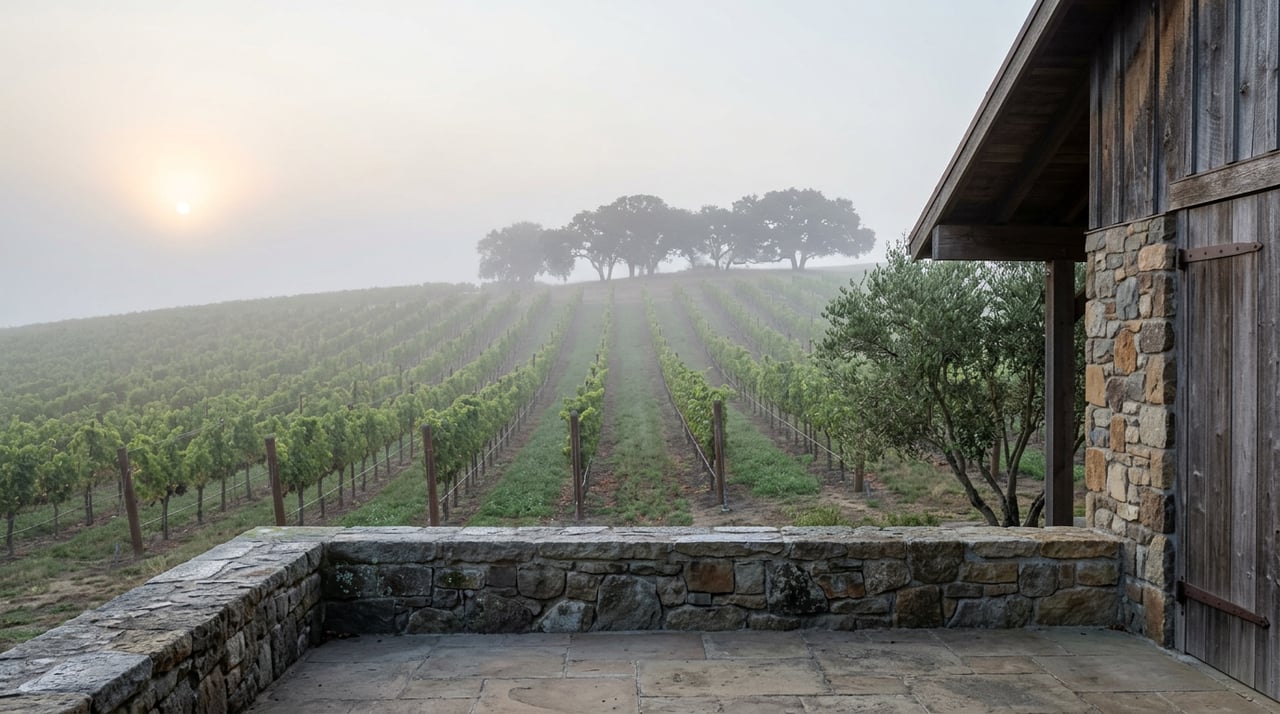
Sonoma County administers agricultural preserve contracts under the state's Land Conservation Act, and a large share of valley vineyard parcels are enrolled. A Type I contract requires a minimum of 10 acres with at least half the parcel planted in a permanent crop, grapes among them, in exchange for the parcel being taxed on agricultural income value rather than market value. The standard term runs ten years and renews automatically each year unless the owner files a formal non-renewal.
The part that catches sellers off guard is what happens next. The contract runs with the land. A buyer inherits both the reduced tax basis and the restriction on non-agricultural use, whether or not anyone flagged it during the walkthrough. If an owner wants out, the county doesn't release the property immediately. Filing a Notice of Non-Renewal starts a phase-out period during which property taxes rise incrementally each year until the contract term ends and the parcel is assessed at full unrestricted value. That is a multi-year timeline layered onto whatever timeline a buyer has in mind for the property, and it has to be disclosed and priced into the transaction, not discovered in escrow.
This is the kind of complexity that shows up in real Sonoma Valley listings right now. In January 2026, the Press Democrat reported that The Wine Group had put Imagery Estate Winery in Glen Ellen up for sale, a property that includes a 55,000-square-foot production facility and tasting room, roughly 4 acres of planted vineyard split between Cabernet Sauvignon and Malbec, and 250,000 gallons of wine storage capacity licensed to produce up to 180,000 cases a year. The listing came two months after the same company sold the historic Simi Winery brand in Healdsburg. Months after hitting the market, the Imagery listing still carried no published price. That is not unusual for an asset this specific. Production licensing, brand entanglements and land-use encumbrances all take longer to untangle than a single-family home sale, and none of that timeline is set by a courtroom in San Francisco.
The other quiet constraint: septic capacity, not square footage
The third friction point rarely appears in a listing description at all. Sonoma County's Well and Septic Division has stated plainly on its own site that the county's soils are notoriously poor for septic systems, which makes permitting a genuinely difficult mission even for straightforward projects. On a rural parcel, the number of bedrooms a house can support isn't set by the floor plan. It's set by how much leach field the soil underneath the property can accommodate, and that is a function of percolation rates the county tests directly.
That mismatch shows up most often when an owner wants to add a bedroom, build an accessory dwelling unit or simply confirm what a five-bathroom estate can legally support. Because the septic system was sized to the original permitted bedroom count, expanding it later can require bringing the entire system up to current code, not just adding capacity at the margins. On top of that, Sonoma County's own well ordinance requires dry weather testing for new or replacement dwellings in its most water-constrained zones, and for any ADU built in those same areas. None of this is optional paperwork. It's the mechanism that decides what a buyer can actually do with the property they're purchasing.
What this means if you're preparing to list
None of these three items resolve themselves on a court's schedule. They're the kind of groundwork that needs to happen before a Sonoma Valley estate goes to market, not during escrow. Before listing, an owner should have on hand:
- Written county confirmation of Williamson Act enrollment status, contract type and any pending non-renewal notice
- The recorded Williamson Act contract itself, if one exists, and its legal description
- Well completion reports, recent flow tests and current bacteriological and nitrate lab results
- Septic permits, the county's Onsite Wastewater Treatment System file, and the most recent pump-out or monitoring record if the system falls under the county's Operational Permit and Monitoring program
- Documentation of any permitted expansions, since an unpermitted addition can force the entire property into compliance review
None of this is a substitute for legal or tax advice specific to a given parcel, and county requirements can shift. It is, however, the difference between a transaction that moves at the pace a seller expects and one that stalls on paperwork nobody pulled early enough.
Does the August ruling mean Sonoma County has stopped issuing well permits?
No. Ministerial review continues for the large majority of applications. The ruling requires the county to complete an environmental study before its CEQA exemption claims are fully resolved, but it did not reinstate the moratorium that was briefly in place in late 2024.
If a vineyard is enrolled in a Williamson Act contract, can it still be sold?
Yes. The sale itself isn't restricted. What transfers to the new owner is the contract's use restriction and its tax treatment, both of which need to be disclosed and understood well before closing.
Does passing a percolation test once mean a septic system can support future additions?
Not necessarily. A system permitted for a given bedroom count reflects the soil conditions and leach field size at the time it was installed. Adding a bedroom or a habitable structure later can trigger a full system evaluation, which is worth budgeting for before a renovation, not after.
Selling a wine-country estate in Sonoma Valley was never going to be governed by a single court decision, and this one shouldn't be treated as the headline that determines your timeline. The contracts already on file with the county and the soil already under the vineyard rows will do more to shape your closing date than any appellate ruling. If you're weighing when to bring a Sonoma Valley property to market, SagePoint Real Estate Company works through exactly this kind of due diligence with owners before a listing goes live. Schedule a private consultation to walk through what your specific parcel's records actually say.